Monday, 19 September 2016

The Rise of Social Media - Keyboard Warriors and the Online Activists

          Ever since the advent of social media, the lifestyle of common man has changed drastically. Each and every one of us has become a judge. We sit comfortably in our offices and pass judgments on people whom we have never even met. When every man has an outlet to express his feelings and opinion in the form of social media, it is more important that one chooses one's words wisely and in a more mature manner. With more and more people becoming keyboard warriors and online activists, I believe it is very important to distinguish between the true and the hoax.

          Online trolls and abusers use their keyboards as swords to kill any opposition for the cause that they might be preaching. People hiding behind the cloak of anonymity are beginning to wreak havoc everywhere. An actress who posts a picture of herself with his close friend is presumed to be a husband cheater and is abused. A sportsperson who posts a picture of himself having his dinner is lashed at for not donating to the poor. Each and every word a celebrity says is twisted and skewed, every sentence is construed to hate religious sentiments and people are getting offended easily. The laying bare of each and every individual's personal life on the online platform have lent an air of intolerance and insecurity among people.
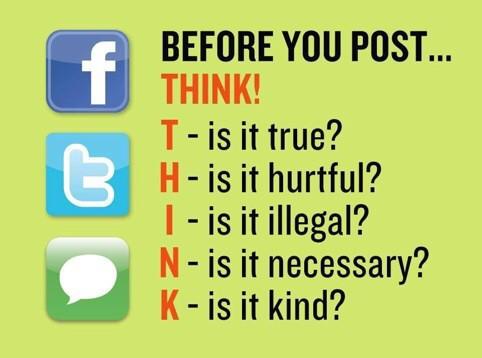
         Men and women keep crying for 'Change' without actually doing anything substantial for the change to materialize. They don't worry if they come across as hypocritical, all they require is that they should register their opinion on almost anything and everything. A man sharing a spectacular video against Child Labour thinks he has done his bit for the society while he forgets the 11 year old boy mending shoes outside his office. There are numerous such instances where people have put up a fake face on the Internet.

          I'm not trying to say such online medium provides only threats to man as a whole. A lot of incidents have been witnessed where the social sites have been used in a productive manner. The December 1, 2015 Chennai Flood is a typical example where the Internet made sure that help reached people even in remote areas as soon as possible. The social media sites served as a platform where people in need posted their grievances and got immediate assistance and relief. That was one incident where humanity rose above the debris of inequality and social media played a crucial role in the overall scheme of things. However, such display of humanity is often marred by terrible incidents where people could have acted more judiciously. A few months back, a young girl was forced to commit suicide by online abusers who kept passing nasty comments on her online page.

          By the look of things, it seems like the Internet and social media are here to stay. As in every other case, the matchstick has been placed in man's hands. It's up to us to either light a candle or burn the house down.


Saturday, 20 August 2016

The Namesake - Jhumpa Lahiri


‘The Namesake’ is the story of a boy brought up Indian in America.

'When her grandmother learned of Ashima's pregnancy, she was particularly thrilled at the prospect of naming the family's first sahib. And so Ashima and Ashoke have agreed to put off the decision of what to name the baby until a letter comes…'

For now, the label on his hospital cot reads simply BABY BOY GANGULI. But as time passes and still no letter arrives from India, American bureaucracy takes over and demands that 'baby boy Ganguli' be given a name. In a panic, his father decides to nickname him 'Gogol' – after his favourite writer.

Brought up as an Indian in suburban America, Gogol Ganguli soon finds himself itching to cast off his awkward name, just as he longs to leave behind the inherited values of his Bengali parents. And so he sets off on his own path through life, a path strewn with conflicting loyalties, love and loss…

Spanning three decades and crossing continents, Jhumpa Lahiri's much-anticipated first novel is a triumph of humane story-telling. Elegant, subtle and moving, ‘The Namesake’ is for everyone who loved the clarity, sympathy and grace of Lahiri's Pulitzer Prize-winning debut story collection, ‘Interpreter of Maladies’.


My Thoughts:

Jhumpa Lahiri

This is one book that every Indian living abroad can relate to. The Gangulis are a traditional Indian family who move to America just before Gogol is born. As Gogol grows up, he is caught between the cultures of his parents' country and the country he lives in now. While his parents embrace Indian culture and everything that reminds them of their home country, Gogol struggles to make sense of it all and India is just a distant nation that is as foreign to him as the moon. While his parents try to grow him as Indian as possible, he tries to put as much distance as possible between him and India.

In this book, the author beautifully portrays the difficulties of settling in a foreign country and the emotional havoc it can wreak on people who are caught in the crossroads of two nations with completely different people and culture. The book is a fantastic read for all Indians, especially the NRIs. The author shows complete command over language and proceeds with the plot in a breezy yet elegant style. At no point in the book did I feel bored or restless.

A few scenes stand out in the book, such as the one when Gogol's father dies and the subsequent consequences the incident causes on the lives of all the other Gangulis, and the scene where Maxine tries to understand Gogol's feelings and emotions but fails to do so. Gogol's mother, Ashima's worries about her children going wayward in a foreign land and Gogol's father, Ashoke's sheer determination to raise his children as intelligent and noble people speak volumes about Indian parents. It is also a great book for some insights into the present generation's mindset at large.

I feel every Indian who is planning on settling abroad should read this book. This book beautifully exposes the merits and limitations on such a move. Spanning three generations, this story is one of its kind.


Quotes

“That's the thing about books. They let you travel without moving your feet.”

“You are still young, free.. Do yourself a favor. Before it's too late, without thinking too much about it first, pack a pillow and a blanket and see as much of the world as you can. You will not regret it. One day it will be too late.” 

“Try to remember it always," he said once Gogol had reached him, leading him slowly back across the breakwater, to where his mother and Sonia stood waiting. "Remember that you and I made this journey together to a place where there was nowhere left to go.”  

About the Author - Jhumpa Lahiri:

Jhumpa Lahiri was born in London and brought up in South Kingstown, Rhode Island. Brought up in America by a mother who wanted to raise her children to be Indian, she learned about her Bengali heritage from an early age. 

Lahiri graduated from South Kingstown High School and later received her B.A. in English literature from Barnard College in 1989. She then received multiple degrees from Boston University: an M.A. in English, an M.A. in Creative Writing, an M.A. in Comparative Literature and a Ph.D. in Renaissance Studies. She took up a fellowship at Provincetown's Fine Arts Work Center, which lasted for the next two years (1997-1998).

In 2001, she married Alberto Vourvoulias-Bush, a journalist who was then Deputy Editor of TIME Latin America. Lahiri currently lives in Brooklyn with her husband and two children. She has been a Vice President of the PEN American Center since 2005.

Lahiri taught creative writing at Boston University and the Rhode Island School of Design. Much of her short fiction concerns the lives of Indian-Americans, particularly Bengalis.

She received the following awards, among others:
1999 - PEN/Hemingway Award (Best Fiction Debut of the Year) for "Interpreter of Maladies";
2000 - The New Yorker's Best Debut of the Year for "Interpreter of Maladies";
2000 - Pulitzer Prize for Fiction for her debut Interpreter of Maladies

Friday, 22 July 2016

5 Books You Must Read In Your Lifetime

Everyone loves reading books. Google estimates that there are around 129,864,880 books in the world. Given the sheer amount of books out there and one's limited lifespan, it can be quite a nightmare selecting your next book. In this blog, from the minor chunk of books that I have read, I try to list 5 books that I feel one must read at least once in their lifetime.


1. The Kite Runner - Khaled Hosseini


          The Kite Runner follows the story of Amir, the privileged son of a wealthy businessman in Kabul, and Hassan, the son of Amir's father's servant. As children in the relatively stable Afghanistan of the early 1970s, the boys are inseparable. They spend idyllic days running kites and telling stories of mystical places and powerful warriors until an unspeakable event
 changes the nature of their relationship forever, and eventually cements their bond in ways neither boy could have ever predicted. Even after Amir and his father flee to America, Amir remains haunted by his cowardly actions and disloyalty. In part, it is these demons and the sometimes impossible quest for forgiveness that bring him back to his war-torn native land after it comes under Taliban rule. ("...I wondered if that was how forgiveness budded, not with the fanfare of epiphany, but with pain gathering its things, packing up, and slipping away unannounced in the middle of the night.")

Click here to read the review of the book.


2. Tuesdays with Morrie - Mitch Albom


           Maybe it was a grandparent, or a teacher or a colleague. Someone older, patient and wise, who understood you when you were young and searching, and gave you sound advice to help you make your way through it. For Mitch Albom, that person was Morrie Schwartz, his college professor from nearly twenty years ago.

          Maybe, like Mitch, you lost track of this mentor as you made your way, and the insights faded. Wouldn't you like to see that person again, ask the bigger questions that still haunt you?

          Mitch Albom had that second chance. He rediscovered Morrie in the last months of the older man's life. Knowing he was dying of ALS - or motor neurone disease - Mitch visited Morrie in his study every Tuesday, just as they used to back in college. Their rekindled relationship turned into one final 'class': lessons in how to live.

Click here to read the review of the book.


3. I Am Malala: The Girl Who Stood Up for Education and Was Shot by the Taliban - Malala Yousafzai, Christina Lamb


          I come from a country that was created at midnight. When I almost died it was just after midday.

When the Taliban took control of the Swat Valley in Pakistan, one girl spoke out. Malala Yousafzai refused to be silenced and fought for her right to an education.

On Tuesday, October 9, 2012, when she was fifteen, she almost paid the ultimate price. She was shot in the head at point-blank range while riding the bus home from school, and few expected her to survive.

Instead, Malala's miraculous recovery has taken her on an extraordinary journey from a remote valley in northern Pakistan to the halls of the United Nations in New York. At sixteen, she has become a global symbol of peaceful protest and the youngest-ever Nobel Peace Prize laureate.

I Am Malala is the remarkable tale of a family uprooted by global terrorism, of the fight for girls' education, of a father who, himself a school owner, championed and encouraged his daughter to write and attend school, and of brave parents who have a fierce love for their daughter in a society that prizes sons.

I Am Malala will make you believe in the power of one person's voice to inspire change in the world.

Click here to read the review of the book.

4. The Story of my Life - Helen Keller


          Recounting her triumph over deafness and blindness and her journey toward becoming one of the most successful and admired women of this century, Helen Keller writes her own remarkable story, providing an emblem of hope and possibility for all.

Click here to read the review of the book.


5. The Test of My Life - Yuvraj Singh, Sharda urga, Nishant Jeet Arora


          A personal account of Yuvraj Singh’s journey through cancer with the 2011 World Cup victory in the background‘

That day I cried like a baby not because I feared what cancer would do but because I didn’t want the disease. I wanted my life to be normal, which it could not be.’

For the first time Yuvraj Singh tells the real story behind the 2011 World Cup when on-the-field triumph hid his increasingly puzzling health problems and worrying illnesses. In his debut book The test of my life, he reveals how—plagued with insomnia, coughing fits that left him vomiting blood, and an inability to eat—he made a deal with God. On the night before the 2011 ICC Cricket World Cup final, Yuvraj prayed for the World Cup in return for anything God wanted. In this book, he lays bare his fears, doubts, and the lows he experienced during chemotherapy— when he lost his energy, his appetite, and his hair—and his battle to find the will to survive. Poignant, personal, and moving—The test of my life—is about cancer and cricket; but more importantly, it is about the human will to fight adversity and triumph despite all odds.

Click here to read the review of the book.


Other Posts You Might Like

Related Posts Plugin for WordPress, Blogger...